the brick

The brick wall in the hallway looks different now just from the coat of the stucco veneziano in bluish teal. It is as though the brick has come alive. Oona, ever the artist, said “Of course it has come alive, that is the magic of a complementary color”. I see the brick in all its glory for the first time. Every color in every brick and every stroke of the blue plaster pops.  I can see nuance in the brick colors that before were in shadow. I see russet colors, greys, creams and even lavenders. This brick was probably laid between the mid-1800’s to the late 1800’s during the boom time in the Lower East Side of New York. As homesteaders in the early 1980s, we unearthed this brick in the interior walls. It was covered in a century’s worth of plaster and wallpaper. We chipped the layers away by hand with a hammer and chisel for a long time till we got to the pure brick. We didn’t work on our individual apartments, we worked collectively, so we were on plaster chipping duties on these walls for months.

I was shitty carpenter. I was bad at measuring and I wasted wood, so I was put on mortar duty. Mortar is more forgiving. The mortar crew was headed up by Smitty, who was an experienced construction worker and he trained a small team of us. We did all of the brickwork in the building. In the warm weather, homesteaders with older kids would bring them in and corral them in a safe part of the building while they worked. I kept an eye on them while I mixed cement. Then they started helping me mix. They made a game of it. We kept the mortar crew supplied with bucket after bucket of cement.

All around us buildings were coming down, victims of the criminal neglect of the landlords who had abandoned them. When a building was torn down, the homesteaders in the vicinity would spread the word and we would all head over there to rescue the brick. We had an enormous canvas mail cart that had been confiscated from a post office. The mortar crew would wheel this cart out and head over to the fallen building. We would find other homesteaders, squatters and gardeners there also rescuing the brick and the stone. We would pick through the rubble to find intact bricks and then stack them on the first floor like cordwood. Our building was restored with the bones of other buildings that didn’t make it.

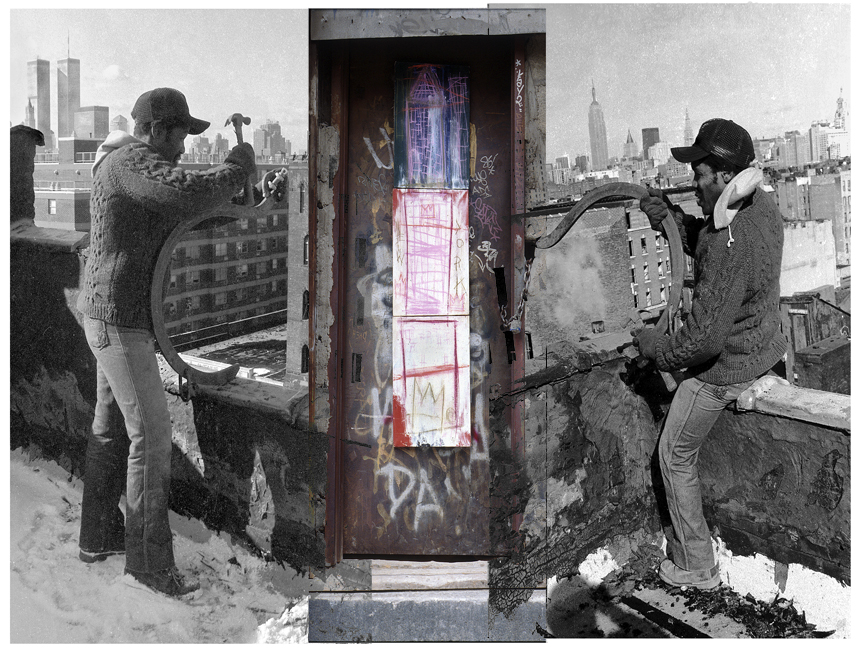
homesteader, photo by David Schmidlapp. www.lapphoto.com

MoRUS, the museum of reclaimed urban space

A very exciting project is underway in Loisaida – a new living history museum that will focus on how the community came together to reclaim abandoned buildings and empty lots and created homes, cultural spaces and lush gardens in what was known as the “Take Back the Land Movement” of the late 70s and 80s. Check out the fantastic video and donate if you wish to get the museum up and running.

My daughter Camelia appears in the beginning of the video when she was little. She is the girl in the pink jacket with purple wings in the Jardin del Paraiso community garden.

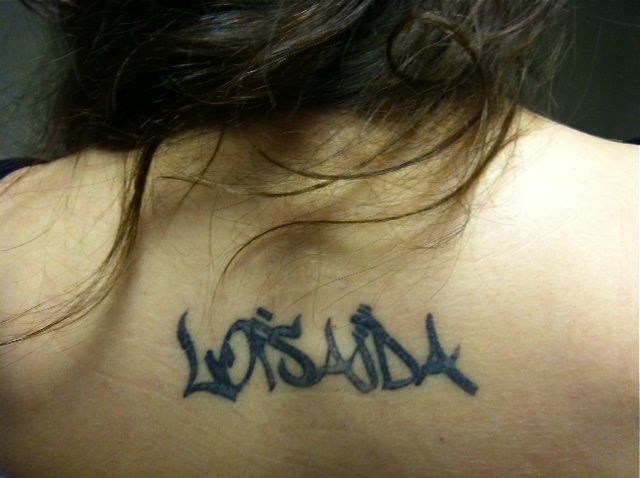
Camelia’s tattoo. The girl has roots.

These previous posts have more information on the history. The Start of the Homestead and Pigeon Wars.

stucco veneziano part one

We’re going bold and complimentary to the brick with a teal venetian plaster. I love to create and apply the plaster. The art is ancient, from before the Romans, who as usual, copied it from the Greeks. The mixing is time consuming and meditative. I mix the plaster by hand in the same bucket I was given as an apprentice when we first stucco’d our building’s hallways in the early 1990’s. I’ve kept that stucco bucket all these years and I carefully scrap and clean it and put it away after each use. It is stained with the patina of all the colors I’ve ever mixed in it starting with the first butter yellow of our hallways.

I don’t know where this recipe originated. I’m sure that if venetian plaster artisans ever saw  it, they would either snicker or groan. The ancient recipes include lime and marble dust. This is the recipe that was taught me so that I could help do our building’s hallways and it is the recipe that I have always used. It works, it holds up. The hallway stucco is twenty years old and it has only been refreshed once.

stucco veneziano in our hallway 1996

Here is the recipe: Mix 1 part flat paint and 1 part water. Add a dollop of wallpaper paste (the natural kind, called wheat paste). Mix in plaster of paris little by little as if you were mixing cake batter till smooth. Finish by adding a splash of milk to keep the plaster from hardening too quickly. Only mix a little at a time at first till you get the hang of the time it takes to harden and how fast you can get it up. Use a real stucco knife imported from Italy. You will not be able to get it smooth enough with any other tool. If you want to repost this recipe, please link back to this post. 

It’s really hard to find the old-fashioned wallpaper paste that was made out of wheat. Now what they sell is full of chemicals. I had to make my own. I found this recipe. It was very easy and it is a good recipe to have if you ever need to make papier mache.

adding the plaster to the paint mixture

it feels like a cake batter

add a splash of milk to keep it from hardening too quickly

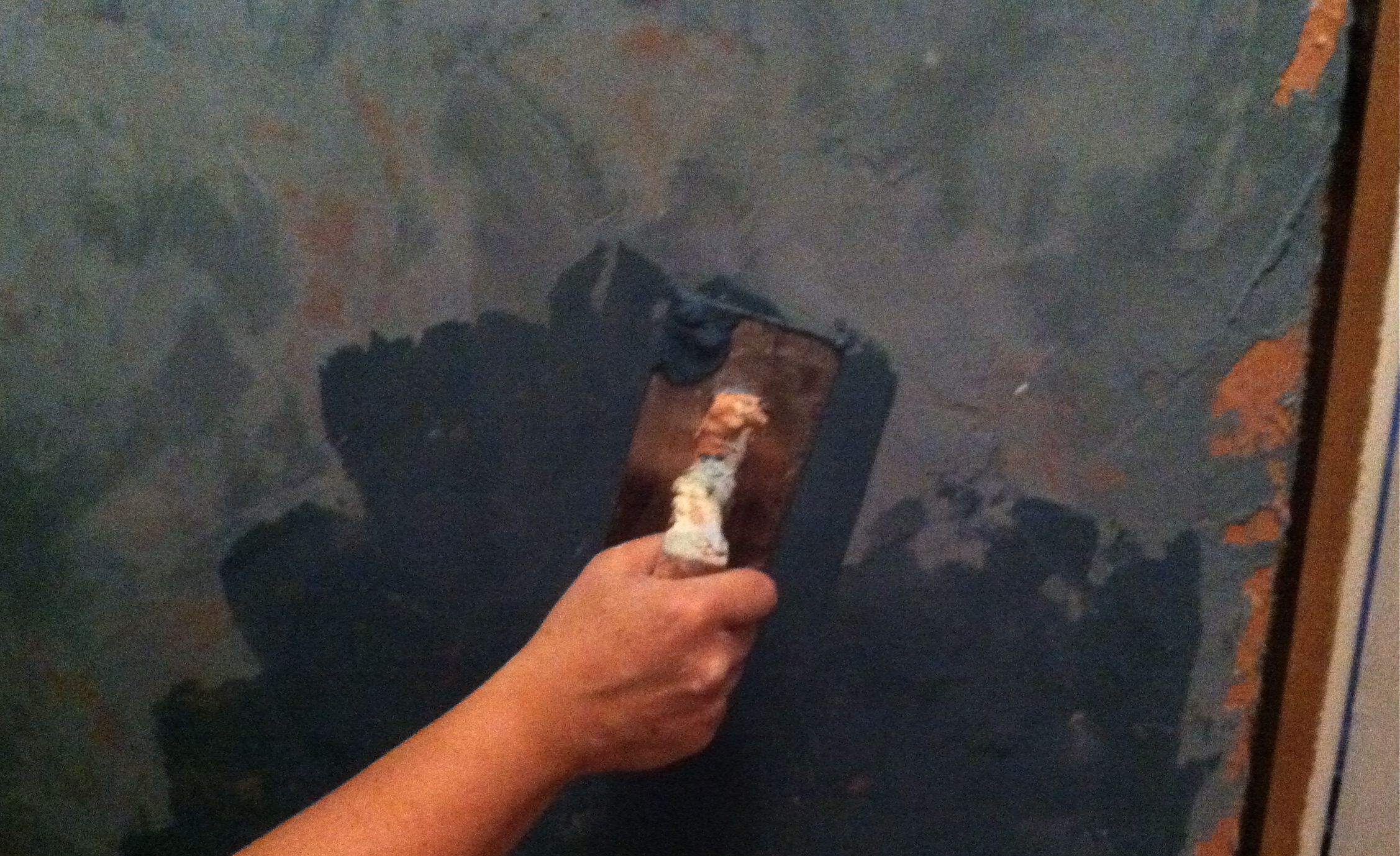
applying the plaster with a stucco knife

Next up will be the finishing touches and the “after photos”. Stay tuned.

venetian plaster in my hallway

The hallways in our building are welcoming and warm. The walls are butter yellow venetian plaster and we have bluish grey apartment doors. When we were rebuilding, one of my fellow homesteaders made apprentices of a few of us and taught us the ancient technique of venetian plaster so that we could help her to do the hallways. She called it Stucco Veneziano and gave us all “stucco knives” imported from Italy. We “stucco’ed” all six stories of our building’s halls in this happy yellow. Our hallway stucco is 20 years old and it looks new. We’ve only refreshed it once in all that time. I will use Stucco Veneziano in my own entryway and share the plaster recipe that you can make yourself.

pigeon wars

The pigeon boys on the rooftop of the tenement building on the corner of Avenue C and East Fourth Street unfurled a red flag over the edge of the parapet. Immediately the cries of “bajando” rose from the lookouts on the street. This meant that a squad car had been spotted and was a warning to the drug dealers to move along. If the pigeon boys had displayed a green flag, the shouts would have been “tato bien” short for “everything is good”, more often than not shortened even more to just “tato”. The pigeon boys bred and trained the birds and kept them in cages on the rooftops. They were kids twelve or thirteen years old. They staged pigeon wars where it was hoped that your lead bird would be strong enough to lead other flocks to your roof and that meant you won the battle. The owner of the hostage flock would have to pay to get his birds back. It was common to see a knot of pigeons swirling in a circular dance lower and lower, hypnotized and lured by a primeval force to land against their will on an alien rooftop. This pigeon dance was so lyrical that I always stopped to watch it. Because the pigeon boys were on the rooftops so much, the drug dealers liked to employ them as lookouts using the flag system. Down below, the squad car would make its way slowly through streets of crumbling burned buildings and empty lots full of broken glass, never stopping, but scattering the junkies like roaches in the light.

Photograph of East Fourth Street in 1984 by my dear friend Marlis Momber. See more of her work at vivaloisaida.org and read more about her here.

after Certificate of Occupancy – the early days

Our home design solutions have always been reactionary. In the homestead we started with a raw space. Babies came as soon as we moved in, The birth of a child would mean we’d buy a new bed for the new person to sleep in.  A newborn’s clothes would occupy one dresser drawer. As the infant became a toddler, it was three drawers. And when they started school, it was six drawers. We’d have more stuff – we’d buy or build something to put it in.   If a neighbor was getting rid of something that we could use – we’d take it. We didn’t have much of a budget to buy furniture and we knew nothing about design. The first baby had a crib purchased by my parents. As soon as she could stand, she would do anything to escape it. It became a place to dump toys in and drape clothes on – a big repository of clutter. So we gave it away, baby proofed everything and put a futon on floor. The second baby never had a crib. She slept first in our bed then moved to the floor futon with her sister.

Our living space was not shaped by design or beauty, only by where to stash things. First, in our raw space, we needed bookshelves, so the ex-husband and his friend built a very ugly bookcase that is still there. The so-called linen closet is the top part of that bookcase. You have to struggle to stuff the linen in because it is not deep. It is so high up that you have to climb on the highest chair in the house to put laundry away. Sometimes we are too lazy and we toss pillow cases into it as if we were playing basketball. It has sliding doors that never worked well and one day one fell off. We thought the second door could fall off and hit someone in the head so we took it off altogether. That meant the so-called linen closet was exposed to the view of everyone in the living room. My mother who could not see very well once thought it was a poster.

the start

The apartment is a 800 square foot one bedroom (which we made into a two bedroom). It has a history. It is situated in New York’s East Village – really in Loisaida, which is a term that is credited to the poet, community activist, playwright and teacher Bimbo Rivas in his 1974 poem “Loisaida”. It is thought to be the pronunciation of a native Spanish speaker of “Lower East Side”. Avenue C is now Loisaida Avenue.

We started out as squatters at the height of the “Take Back the Land” movement of the 70s and 80s when landlords were burning down their buildings to collect the insurance money in the marginalized neighborhoods of a bankrupt city. Ours was a burnt out abandoned building. Majestic in size, our building is wide and expansive, not like the narrow tenement buildings so common in our historically immigrant neighborhood. Our hallways are wide and our apartments too, not like the more common railroad flats. When neighborhoods were more segregated, the community’s middle class could not move out to the suburbs but stayed put within their ghetto. There are buildings and entire blocks in our neighborhood that were obviously the homes of the doctors, lawyers and religious leaders of the community. There was a doctor’s office on our building’s first floor. We had to rip out the subway tile that lined the walls from floor to ceiling. The doctor probably lived upstairs.

In the early eighties, the neighborhood landscape was that of a bombed out city. Landlords burned and abandoned their properties. Residents went without basic services like heat and water. Entire areas were abandoned by government. There began a movement to take back the land in every respect. People took over their own buildings that landlords had stopped lording over and started managing themselves. People took over abandoned burnt buildings and rebuilt them. People took over empty lots and turned them into gardens. People took over abandoned schools and turned them into cultural centers. People took over abandoned banks and turned them into community banks that lent money to the homesteaders that took over the abandoned buildings.

When I came to my building, the group that had seized it had already been working for a few months and had just finished clearing  out the debris. When I came in October of 1980 we were starting the job of replacing beams and floors. It took us 12 years of working every weekend to finish rebuilding. We are twenty families – we had to stay cohesive as a group. We had to shape and respect a democratic collective process. We were also part of a movement. We were connected and in solidarity with all of the other players that were rising up out of the ashes in the neighborhood.

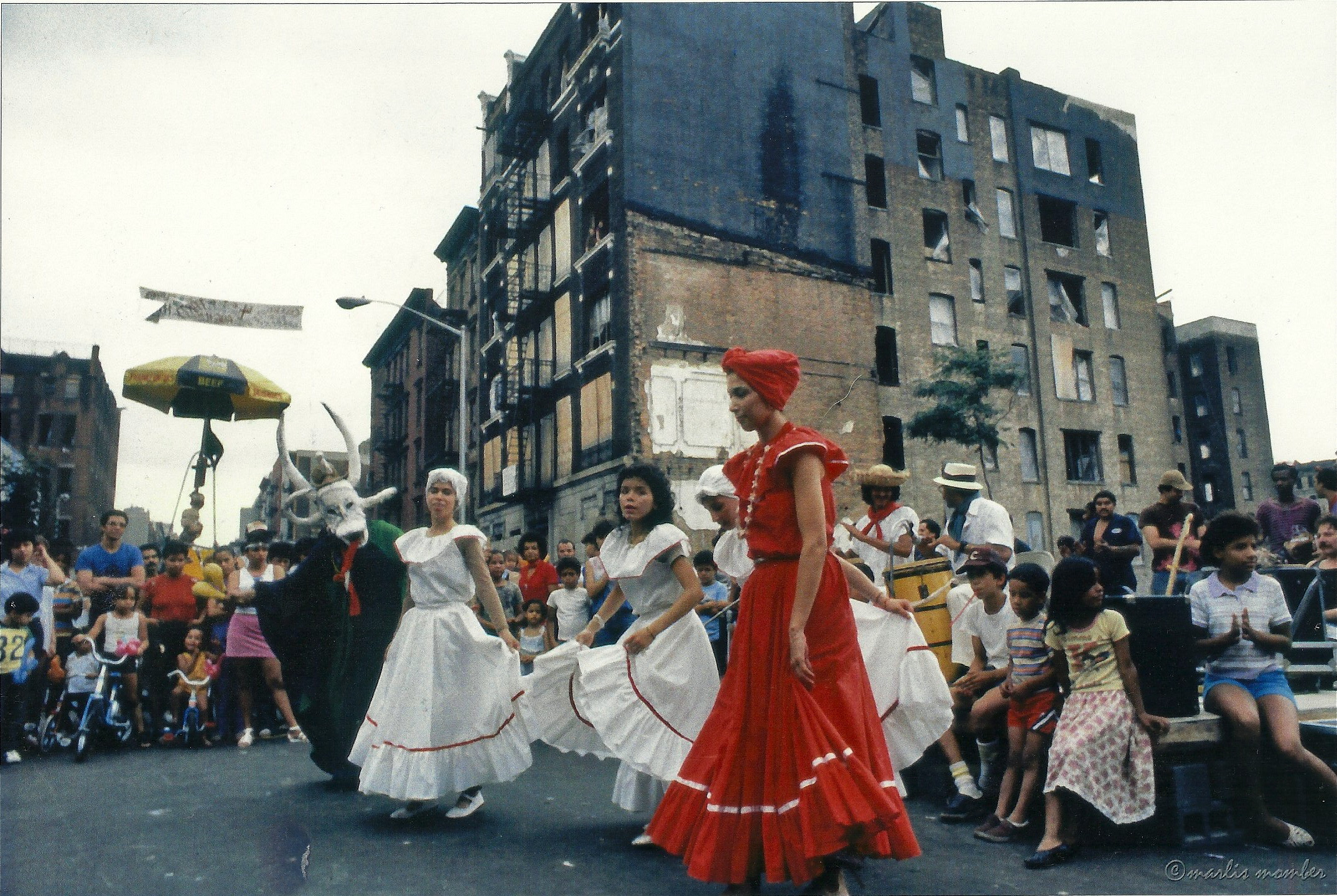
festival in the mid 80s with our building under construction in the background. Photo by Marlis Momber - vivaloisaida.org