summer’s end

I spent the summer in a 1976 Marlette trailer home in the northern Catskill mountains. Our rural homestead is totally off the grid, without electricity (until this summer) or running water. I love that when you stand at the mailbox and look down the road, you don’t see any electrical poles. It makes me think, what a pristine place, so pristine that I once saw a fisher cat cross the road in full daylight. A fisher cat is a creature so wild that it only exists in a place where nature is in balance and the forests are deep. At the end of summer, yellow goldenrod in full bloom grows thick on the side of the road and the colors of the vegetation change and take on a muted hue – soft purples and maroon start to appear among the lush green leaves.

This summer we installed an off the grid solar energy system (more on that to come), we made a lot of good meals, getting our vegetables from our neighbors “honor system” style roadside stand and our eggs and meat from our friends at Heather Ridge Farm. I am now spoiled by the eggs with bright orange yolks laid by happy hens who peck in a garden eating bugs and other good things. We gathered with beloved friends around bonfires and listened to the coyotes at night. We swam in the inky black water of ponds as smooth as glass and in swimming holes underneath waterfalls. The smell of the last hay harvest was always in the air.

So long summer – see you next year.

Marlette trailer

Marlette trailer

Morning mists at Heather Ridge Farm

Morning mists at Heather Ridge Farm

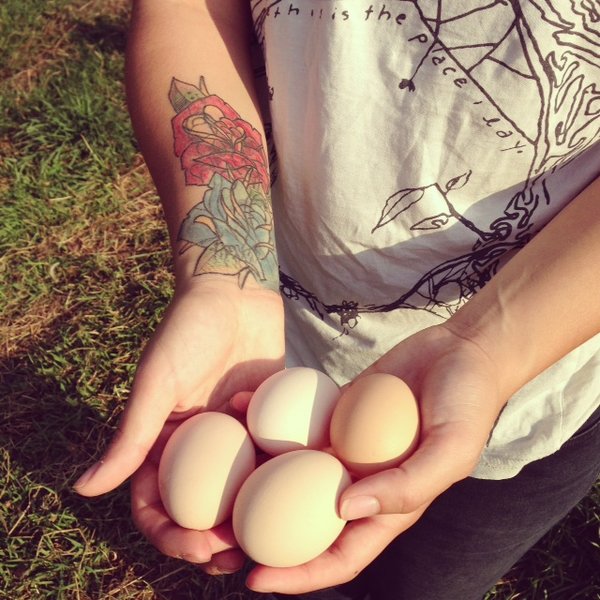
Eggs from Heather Ridge Farm

Eggs from Heather Ridge Farm

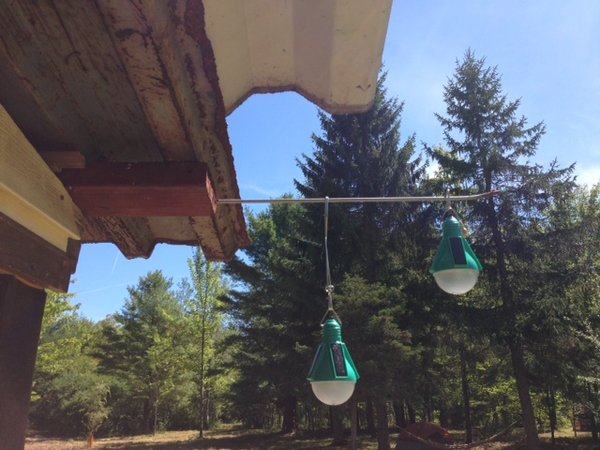
The sun charging our Nokero solar light bulbs

The sun charging our Nokero solar light bulbs

Twilight in the hayfield

Twilight in the hayfield

David, Frank and Oona

David, Frank and Oona

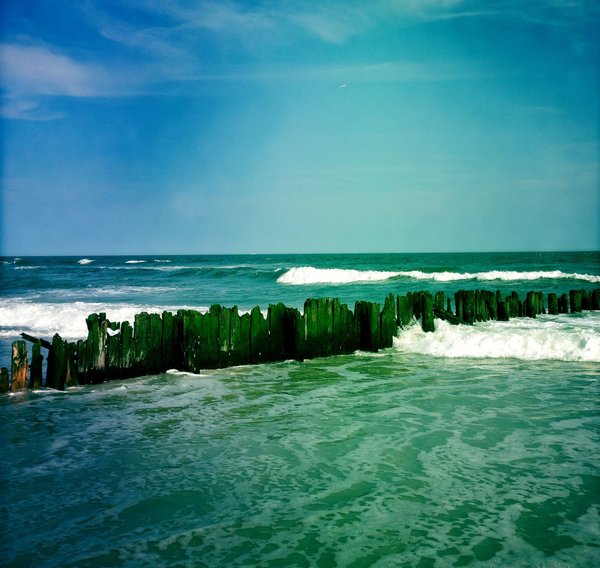
rockaway beach after the storm

Last summer we rediscovered Rockaway Beach. It’s easy and cheap to get to, just a couple of subway trains, then a couple of blocks and you are on the boardwalk. Nothing like the odyssey of getting to Jones Beach where you have to take the subway to Penn Station to take a Long Island railroad train, get on line to buy a ticket for that,  and then a shuttle bus to the beach. The wait for these vehicles on the way back feels so long when you have sand in your sneakers and you are sleepy from the sun.

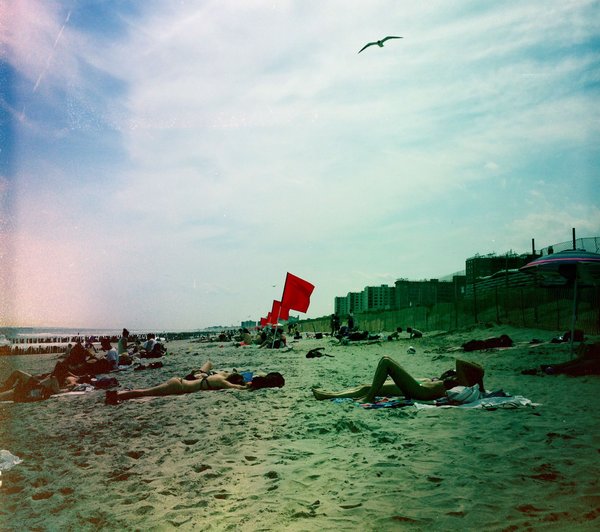
hipstamatic: john s. lens & dixie film

hipstamatic: john s. lens & dixie film

The ocean at Rockaway is clean and the surf is strong. The crowd is what you will only encounter in New York. Teenaged boys with their bathing trunks slung down under their butt cheeks with underwear over top. Large families with multiple umbrellas and gigantic coolers on wheels that they pull over the sand. Women in hijab and flowing tunics with their pants legs tied tight under their knees as they cool their legs in the salt water. Tattooed girls in high waisted bikinis with scarfs over their florescent colored hair to keep the sun from fading it.

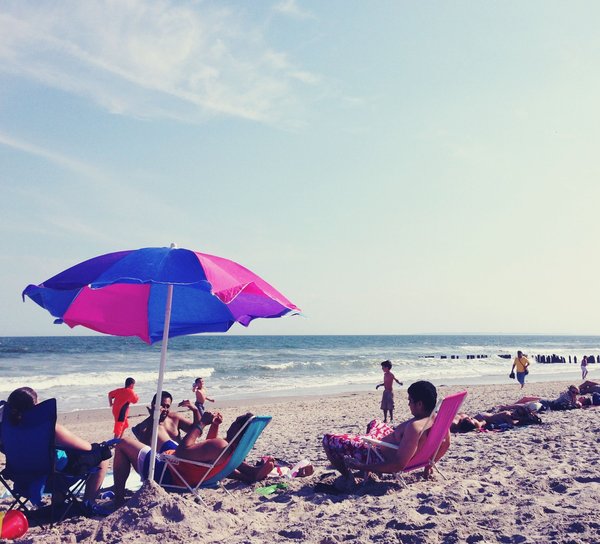
hipstamatic: john s. lens & dixie film

hipstamatic: john s. lens & dixie film

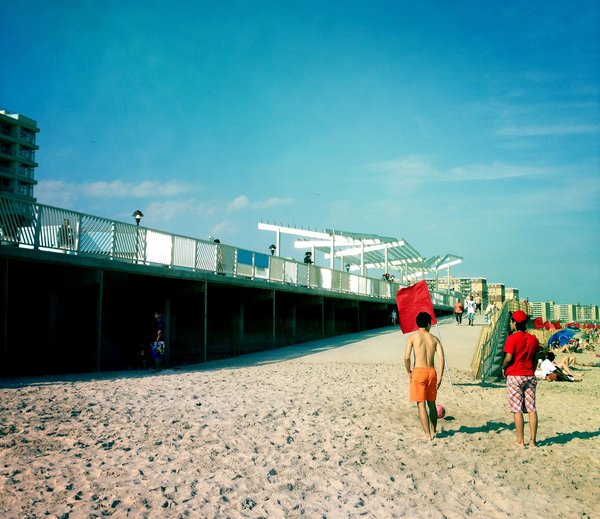
We are on Beach 97. The sun warms your skin in between the little puffs of cool breeze that blows in from the ocean. There are dads playing catch with small children using Frisbees, footballs and softballs. I think to myself, “someone is going to get bopped in the head”. But New Yorkers are so used to moving in their own spaces within a crowd, that it never happens. The water is still icy, so the only people in it are the surfer boys in neck to toe wet suits and little children who hinch their bodies upwards when the cold seafoam hits their ankles.

hipstamatic: helga viking lens & blanko film

hipstamatic: helga viking lens & blanko film

hipstamatic: john s. lens & blanko film

hipstamatic: john s. lens & blanko film

Last summer, before Hurricane Sandy, the boardwalk here had a lively scene with bike rentals, food stands and live music. The boardwalk with its faded grey wood in a beautiful chevron pattern was destroyed and swept away by Hurricane Sandy. The old plank wooden stairs leading down to the sand are being replaced by a sloping concrete ramp. The sights of rebuilding were everywhere. It was a good thing to see.

new boardwalk ramp. hipstamatic: john s. lens & blanko film

new boardwalk ramp. hipstamatic: john s. lens & blanko film

For an article with interviews from residents on the rebuilding see: Rockaway Resurrection: Rebuilding the Beach After Hurricane Sandy.

the robin’s nest

As spring turns into summer, we begin to spend more time in our rural abode in the Catskill Mountains of New York State. More of my posts will be from there this summer. We have a trailer from the seventies that is just the size of a New York City apartment set on a wide meadow surrounded by a pine forest. We are off the grid with no electricity or running water. I call us people of extremes, equally comfortable at both edges of city and country.

June 14, 2013

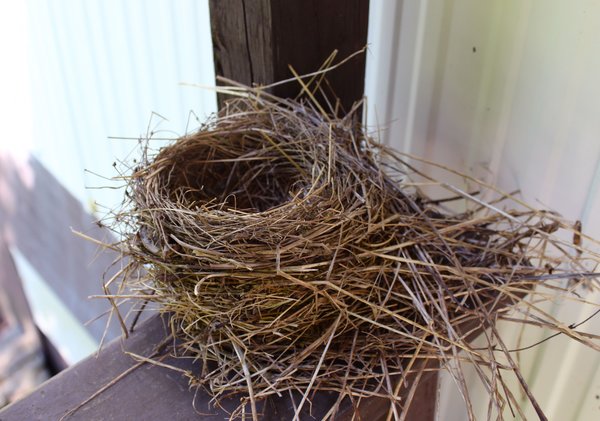
The hay in the back meadow is as high as my waist. We have not been here for three weeks and nature has encroached on us from all sides. My mind is on the little nest of newborn robins. It was sitting right on the bannister of the porch inches away from the front door. Inside were three newly hatched baby birds. They were naked with only tufts of bright yellow fluff on their heads and their eyes still shut under bulging blue lids. I peer inside the nest and they sense my presence. They blindly stretch their necks out and open their yellow-rimmed beaks towards me to be fed.

rforest_circle_hipstamaticRev

I think we must move the nest. I cannot imagine that the mother will sit on it inches away from the opening and closing of a front door and at waist height of the back and forth of humans and dogs. I decide to move it to another bannister just a little further away from the front door with the hope that the mother will feel safe enough to continue tending her nest. We see her flitting from one branch to another crying piteously. We shoo the dogs into the house and decide to go into town early to give the mother peace and quiet so she can find her nest.

Once in town, I call Oona, who knows a lot about animals after having watched countless hours of Animal Planet. She thinks we did the right thing and that the mother will find them. Frank says that the nest is not secure on the new bannister and will blow over in the wind. He wants to hammer some nails into the bannister to create a support system. I think that will scare the mother more. Over dinner, we argue the merits of over wire versus nails for a nest supporting system. I think about how involved we are in what is such a small matter when you think about the suffering in the world. But, you can’t help but respect the maternal instinct no matter whose it is. And, we want nature to succeed.

rsz_robin_nest

When we return, Frank peers into the nest and says, “They are almost dead.” The baby birds do not make it. She picked a bad spot. Maybe she was a new mother without experience, that she would build a nest so low and within a human structure. Later, I read that mother robins have “nest fidelity” which means that they memorize their nest as they build and if you move it, they will not recognize that nest as theirs.

It is now 8:30pm and it is still full light out as we approach the summer solstice. There are two robins in the grass outside my window. I watch them hopping around hunting bugs. They fly off in the direction of where we relocated the nest. Maybe they will try again this season. It is still spring.

UPDATE: Two weeks later we return and see a mother robin sitting on a nest under the eave of the shed. She is sitting on an old nest that had been there unused for at least a year. I think it is our mother robin. I think that she used the old nest because she did not have time to build a new one. This time, she is successful.

violets, part I: a mother’s day story

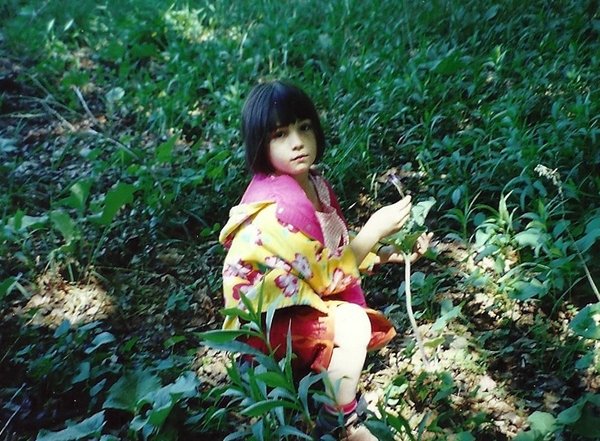
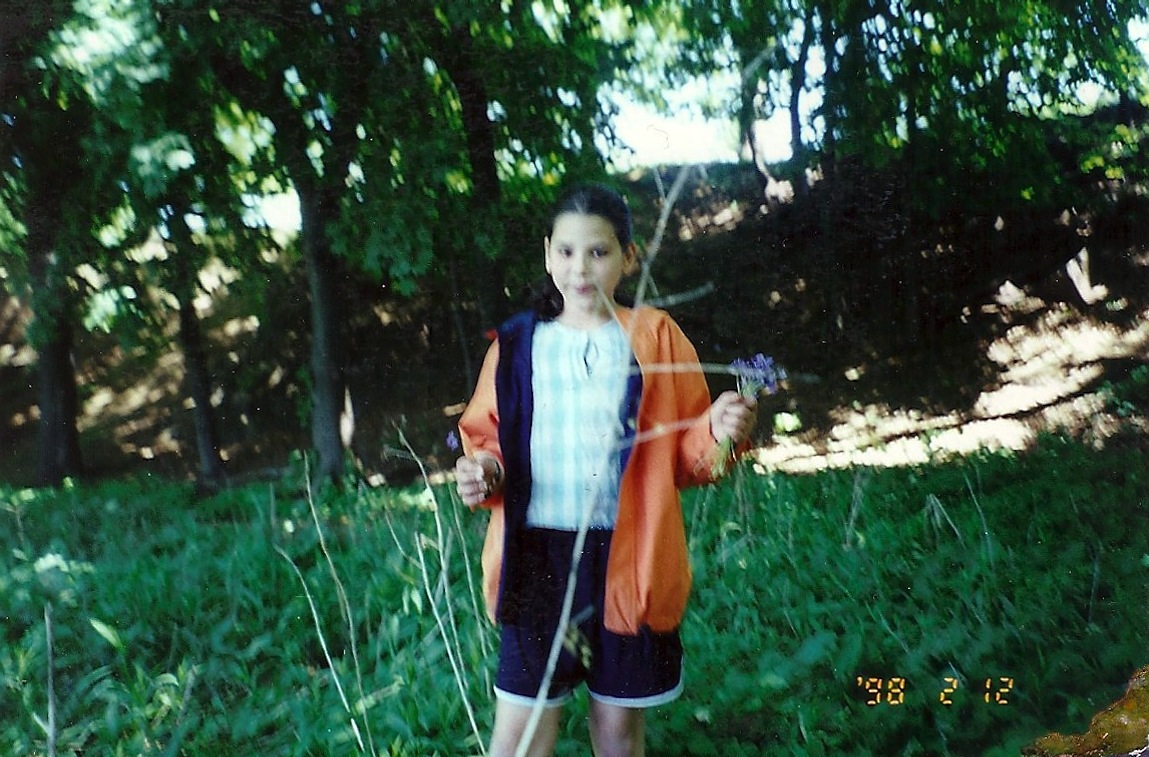
The day begins with violets. The tradition of picking violets for my mother started when my first nephew was four years old, long before I was a mother myself. One early Mother’s Day morning, I took Luis José to walk my parent’s dogs in the neighborhood park. The park had a section that was ignored by the landscapers and thus was wild and beautiful. On the edges of the manicured sports fields and running track, there was a small forest with big boulders spread around. Luis José loved to climb the smooth rocks that felt gigantic to him. There was a well-worn dirt path that ran down into the park from the tiny forest. It ran down and then up, like a roller coaster track. It was great fun to run down at full speed and so Luis José, the dogs and me ran down and suddenly found ourselves in a leafy hollow that was filled with wild violets. We waded into the greenery and starting picking. Luis José, with his brown eyes smiling, proudly marched home holding two fat bouquets of the delicate flowers, one for his mother and one for his grandmother. The hunt for wild violets in the park on Mother’s Day morning became a tradition and when his little sisters and my own daughters were born, they all joined in.

Camelia_OonaVioletsRaw_ff

rsz_camelia_violets

rsz_oona_violets

I taught the children how to pick the flower from the bottom so that the stems would be nice and long. They children searched for the hidden violets in the ivy-covered hollow, shouting out to each other when they found a particulary abundant cluster. The older cousins would help the littlest ones so that they would have a respectable bunch to present to those of the matriarchal line. My mother was the number one recipient of the floral booty. Everyone understood that the violets were meant for her. She was top mom. She got the most. The other mothers got a gesture.

Camelia_Violets2

rsz_oonabehindleaf

My mother had a wooden corner cupboard with glass windows where she kept her best china and crystal. She was very proud of that cupboard. It was an extravagance that she purchased as a newly arrived immigrant. Every morning on her way to work, she’d walked past a furniture store and admired that cupboard. So, she made a deal with the storeowner and gave him five dollars every week from her paycheck behind by father’s back until it was paid for. She brought it home and filled it with the things that she thought were the most beautiful.

The little band of cousins would return from the park with fists full of violets. The children burst into the house and clustered around their grandmother offering up their bouquets of white and purple wild violets. My mother would go to her wooden cupboard and ceremoniously pull out her crystal champagne flutes and place each child’s bouquet in one. She would then set them all in a row on the dining room table where the sunlight would catch the etchings in the crystal flutes holding the gifts of violets. Happy Mother’s Day.

rsz_grandmother_child

the equestrian chronicles part I

What are horse dreams made of? When I was a little girl on family drives in the countryside, I would imagine myself astride a magnificent horse galloping alongside the car. The horse’s mane, tail and my own long hair flew behind us.

I come from a family of horse people. On school holidays my father was sent from his provincial town to stay at his aunt’s boarding house in Havana so that he could study horsemanship at the Spanish Equestrian School. My father was an expert horseman and he loved Palominos most of all. He had at least two that I know of. His favorite was a giant stallion named Napoleon.

Top from left: Camelia's grandfather; great grandfather and grandfather; great grand mother. Bottom from left: Camelia's grandmother; grandfather; grandfather with great uncles. Cuba

Top from left: Camelia’s grandfather; great grandfather carrying grandfather; great grandmother (on left). Bottom from left: Camelia’s grandmother (on left); grandfather; grandfather (on left_ with great-great uncles. Cienfuegos, Cuba

Growing up, my father told me horse stories and I wove all of them into dreams of Palominos and the dappled greys that I loved the best. But they remained fantasies because I was a city child. Sometimes on birthdays I would be driven to a stables in the outskirts of the city and treated to a trail ride.

When my father told his horse stories to his grandchildren, only one of them heard. It was my oldest Camelia who clung to his every word and wove her own horse fantasies. She was the one who got her friends to play “Black Beauty” in kindergarten and read every book in the series by the fourth grade. Camelia wore out the videotapes of the “Horse in the Grey Flannel Suit” and “National Velvet”.  As a city child growing up in Loisaida, Camelia’s horse dreams were just like mine, only fantasies – not attainable, really.

Things changed one very boring weekend in late winter when we were feeling the cooped-upness of February. It was dull and snowless and everything was brown. Over my morning coffee I decided an outing ought to be taken. Maybe I could take them to a real stable for a proper riding lesson. Camelia had never been on a horse outside of the occasional school street fair pony and in her own horse dreams. We found Frog Hollow Farm and at the age of seven, Camelia sat for her first lesson in her blue jeans on the stalwart school pony Ludwig.

That was when Camelia’s horse dreams changed from being images on a TV screen and in her mind’s eye into the real smells of leather and horse sweat, and the mastering of skills.
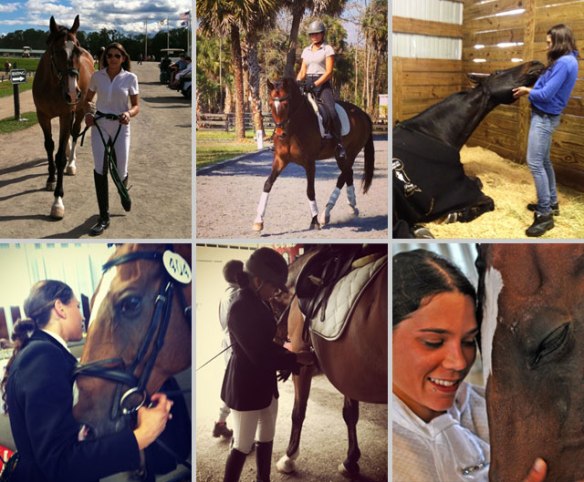
Camelia at HITS on the Hudson and Wellington, FL

Camelia at HITS on the Hudson and Wellington, FL

In the summers my parents sat on a grassy knoll in old wrought iron armchairs overlooking the outdoor rink to watch Camelia in her dark green riding breeches.
Her grandfather would watch the only child of his line to have realized her horse dreams. I could see the pride and satisfaction in his green eyes. His gaze intent on horse and rider, he would smile softly and nod approvingly as we sat under the shade tree. In her training he saw his training and it continued, this ancient connection to the horse.

At the age of fourteen, Camelia became a working student where the trade was work in exchange for riding lessons. All through high school, Camelia would rise every Saturday morning before dawn to catch a bus to the farm, and returned home on Sunday evening. She did her homework on the bus ride. I used to joke that she had the discipline of a Marine. She would surf the internet for horses that were for sale. Often, while cooking dinner, I would hear her yell “Mom, come look at this one, what a beauty!”

I missed her when she went to the farm on the weekends and then as she grew older for longer periods of time during summer vacations. But I let her go, because I understood this horse dream. My daughter has a gift. Maybe this gift is in the blood. She is after all, only one generation removed from people who were physically connected to the horse for centuries. People who sat astride horses from toddlerhood until they died or could not get out of bed.

Camelia Montalvo is a dressage instructor and trainer in New York. At the time of this writing, she was a working student for Jennifer Baumert of Cloverlea Dressage in Wellington, FL for the winter season.  

the dove’s tale – a mother’s day story

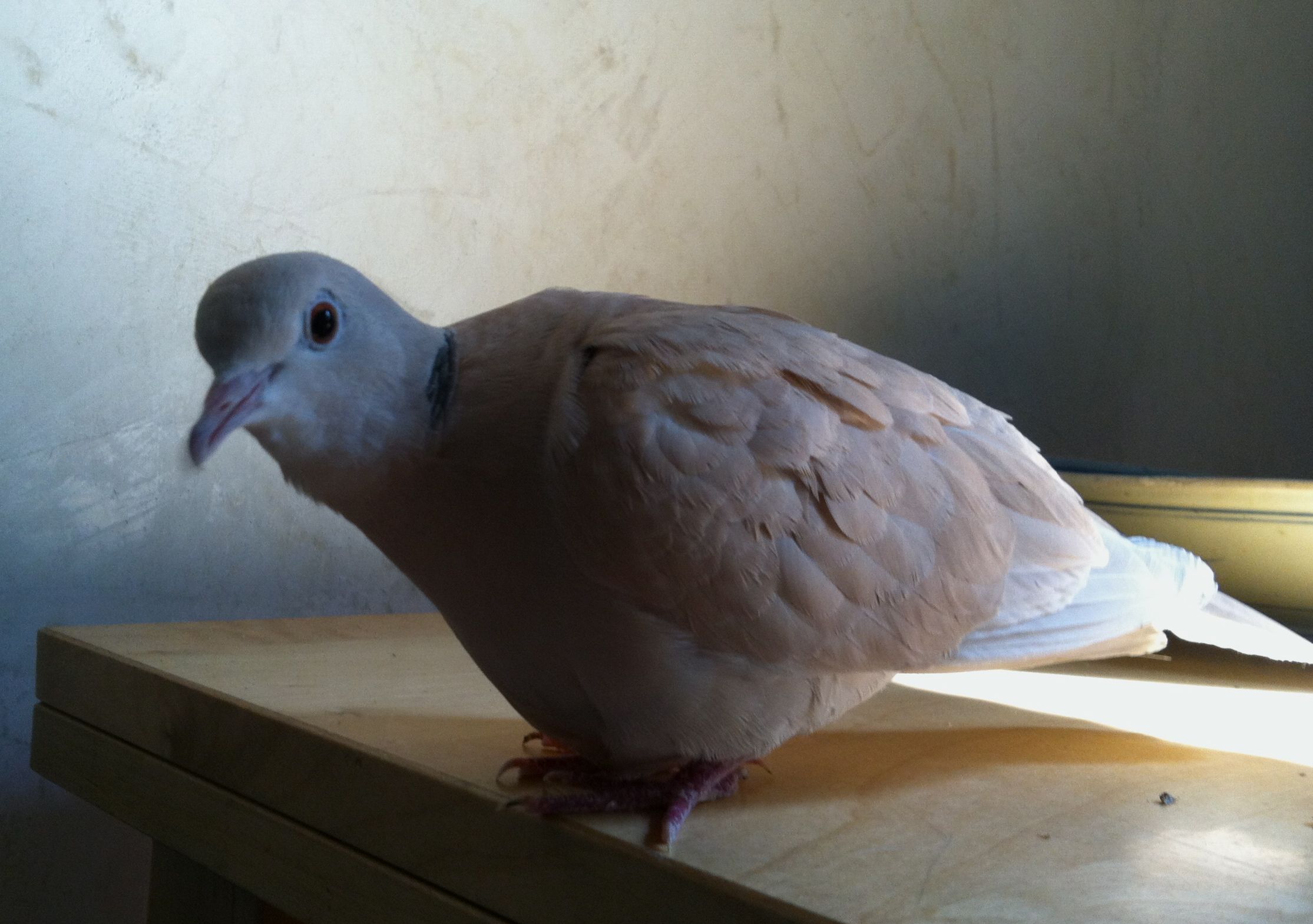
May 11, 2003, on the anniversary of my mother’s birth in the year of her death, I was walking home with my daughter Camelia in the late afternoon sun. The street trees in front of the apartment building were heavy with brand new leaves. They cast dappled shadows on the sidewalk in front of our door, so that at first we did not see the little dove standing there. We approached her slowly and she did not move. We were surprised that she let us get so close. Suddenly, she flew up like a helicopter into the tree. She was clumsy and it was clear she was not used to flying. She then soared off the tree and slammed into the garden fence. This stunned her and she fell to the ground. I was able to pick her up. I cupped her in my hands and brought her inside. While Camelia unlocked our front door, the little dove’s pupils dilated wildly with fear and her head turned all the way around like Regan in the Exorcist. I told Camelia to go fetch the dog kennel from the basement to put her in. The dove was home.

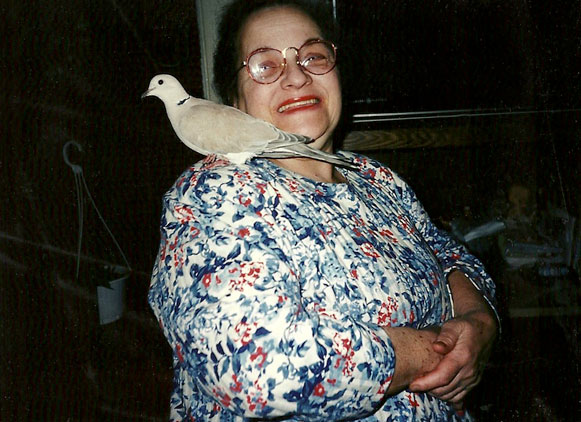
My mother had a ringneck dove she named Cucu. She and my father found the dove sitting on the hood of their car in the garage one cold morning in late autumn. They could see that it was not a wild animal and it would not make it through the coming winter outdoors. Like mine, it was an escaped pet. The dove allowed them to capture him and cup him in their hands and bring him inside. Cucu became a beloved pet who had free range of my parent’s house. When my mother died, a friend of hers who lived alone promised us that she would let Cucu fly free in her house and so she took him in. At the time, it seemed for the best. But I secretly regretted not having taken Cucu myself.

At the time of our dove’s arrival, it was the first mother’s day I would experience without my mother. The dove is a presence. A gift. She is a balm to my heart.

tree trimming party

My daughter calls me an ornament hoarder. I’m always on the lookout for the old ones at yard sales. Sometimes I find them at the bottom of big boxes and I know that they’ve come from someone’s attic – someone who has died – someone whose children and grandchildren saw these shiny treasures as junk. I rescue them to hang on a lighted tree again. They have good energy. I like them when they are so old that they start to become translucent and the light penetrates their milky luster. The old glitter looks like tarnished silver. I have handmade ornaments that when they are unwrapped and hung on the tree each year bring an endearment of thought. The wool roving ornaments made at a school holiday fair. The pressed cinnamon reindeer from preschool. The delicate orbs of blown glass from middle school science class filled with colored water. Ornaments brought by our friends through the years are remembered and hung on the tree with love.

TreeTrimReindeerOrnament

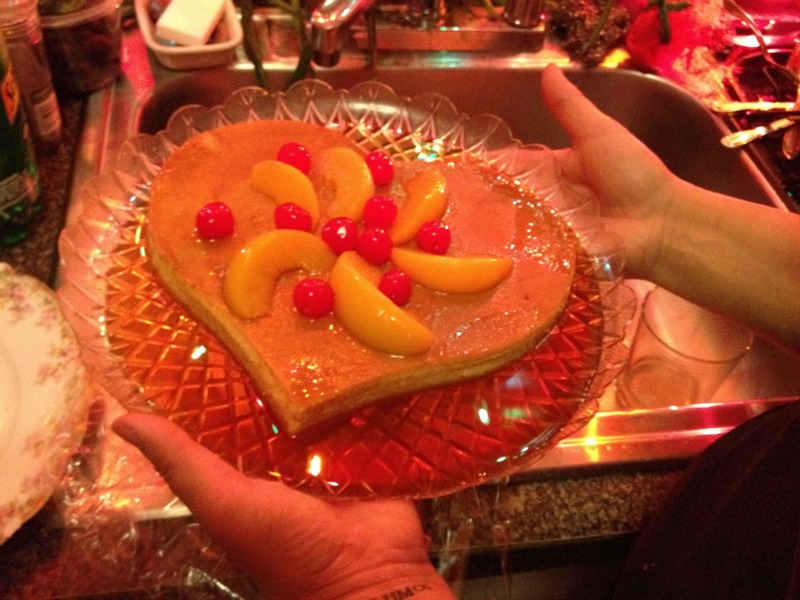
In the beginning, we had friends over and just ordered pizza from Two Boots while we worked on the tree. Some years later I got the idea that I should make it fancier from watching a show on the Food Network about holiday hors d’oeuvre and for a couple of years I woke at dawn and stressed myself out in the kitchen until one of my daughters said “Mom, we liked it better when we just had pizza from Two Boots”. This year I did order pizzas from Two Boots and we made three different kinds of deviled eggs –  easy and delicious. I tinkered with recipes from epicurious.com. I served the adults Dark and Stormy cocktails – a good wintery drink.

Chipotle Deviled Eggs

7 eggs (makes 14 halves0
1 chipotle pepper from a can (with adobe sauce) seeded and chopped fine
salt and black pepper to taste
Mayo – good quality or homemade

Hard boil the eggs and cut in half. Scoop out the yolk into a mixing bowl. Smash up the yolk, add the chopped chipotle and salt and pepper. Add enough mayo for a consistency like dry frosting. Stuff lightly into the halved whites.

Tarragon and Capers Deviled Eggs

7 eggs (makes 14 halves)
1 tsp fresh tarragon chopped fine
1Tbs shallot or green onion chopped very fine
1 Tbs capers
Mayo
Salt and pepper to taste

Same as above, but add the chopped tarragon, capers and mayo. Stuff lightly into the egg whites and add one caper on top for a garnish.

Regular Deviled Eggs

10 eggs (makes 20 halves)
½ tsp dry mustard
½ tsp cayenne pepper or smoked paprika
Mayo
Salt and pepper to taste

Same as above, add the mustard, pepper or paprika, mayo and salt and pepper. Stuff lightly into whites and sprinkle with paprika on top.

Dark and Stormy cocktails

Splash of Goslings Dark Rum in a tumbler over ice
Fill with Reeds Ginger Beer or other good quality ginger beer
Squeezed lime

TreeTrim_milliUP

TreeTrimsuperflan

TreeTrimMStree1

pomanders and paperwhites

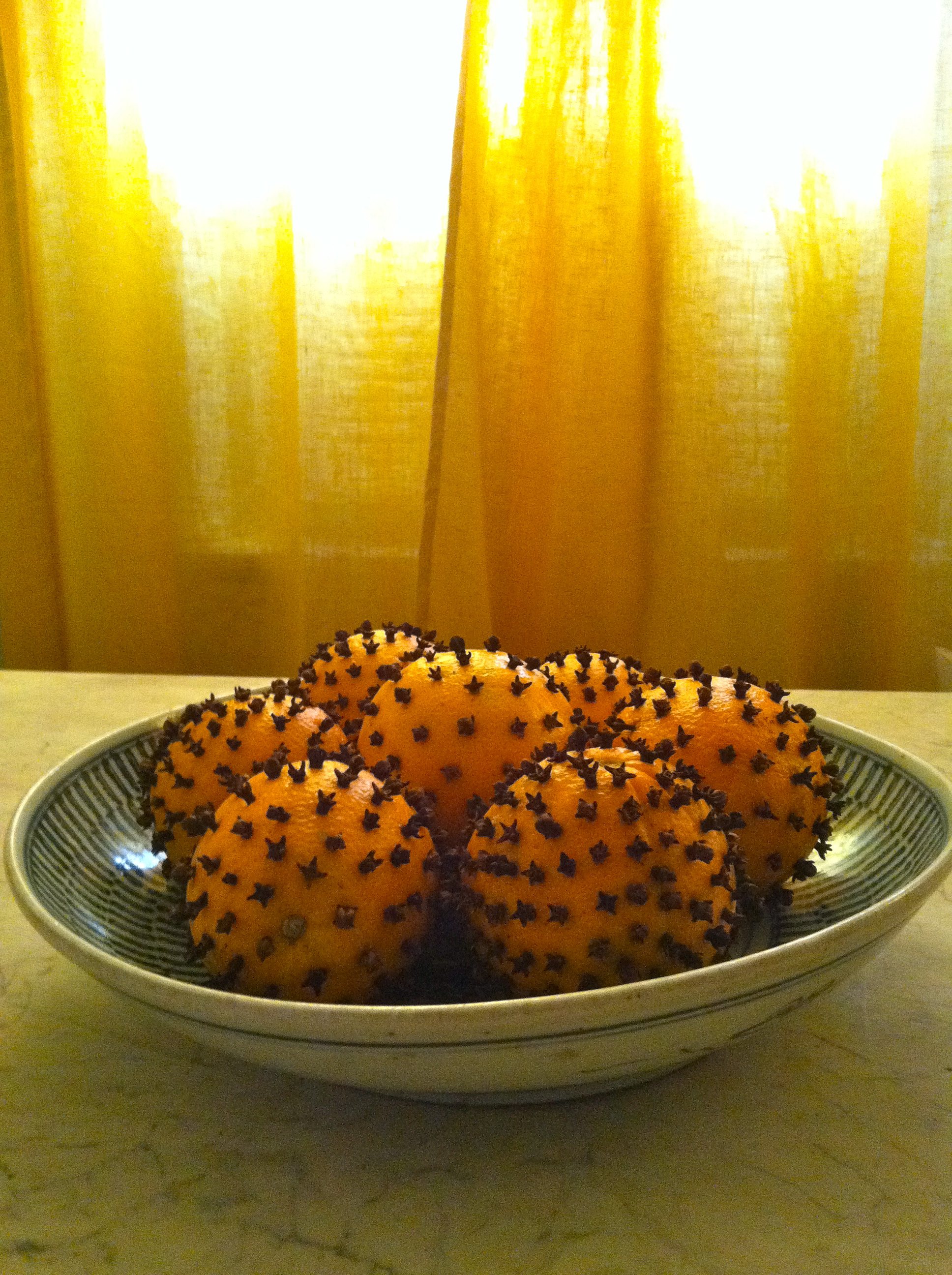
Smells are important. They say that smells are what most easily triggers the memory. A smell will transport you to another time and place immediately and sometimes against your will. At times you don’t even know where you’ve been taken, only that you’ve been there before. In our home there are smell memories for Christmastime. Shortly after Thanksgiving, ever since my children were very small, I have been buying thin-skinned oranges and a big jar of cloves to make pomanders. We sat around the table with a bowl of cloves and a pile of oranges, spearing the cloves right into the orange – sometimes in fancy patterns and sometimes just plain around it. When the clove pierced the skin with a satisfying pop, orange oil would bead up around the fresh wound.  Soon the apartment would be filled with the scent of spice and fruit so strong that it wafted into the hallway and delighted the neighbors too.  By Christmas the pomanders would be cured and we tied them with red and green ribbons and hung them from the doorframe so that you could smell them the strongest when you walked into the house.

I’d never heard of paperwhites until one day shortly before Thanksgiving, a co-worker asked me if I wanted to chip in on a bulk order of the bulbs for Christmas. I did and every year since I put paperwhite bulbs in water and I keep them blooming in batches through the deepest dark winter months. The first batch is timed so that it blooms right before Christmas. I remember that when I started this tradition, I wondered if the earthy and very un-floral scent of the paperwhite would become a smell memory for my children. When they were grown up and far away, if they smelled a paperwhite flower, would they be transported home at Christmastime? Would they remember?