foliophoto

I’ve been participating in a photography group called foliophoto dreamed up by Sandra Harris of Raincoast Creative Salon and Christie Jones of Bedsidesign. Its a Flickr group and we’d been doing weekly photo sharing. Every Tuesday we got a word prompt as the idea for the photograph. For the month of October, they decided to step it up, so every day we had a daily word prompt and we took a photo to share on Instagram. Some prompts were elusive till the last minute. All day I would turn ideas over in my head and suddenly turn a corner, see something and say “Aha, there it is”.  At times I felt like I was doing the Bikram yoga 30 day challenge again.

I enjoyed “meeting” interesting and talented folks through this group and getting a glimpse of their landscapes. The prompts have been interpreted in varied and sometimes surprising ways. Most of all, I’ve been inspired.

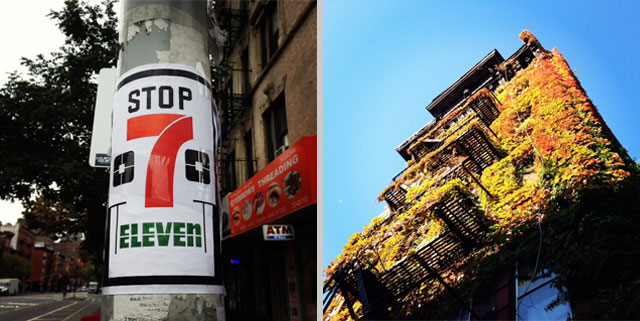
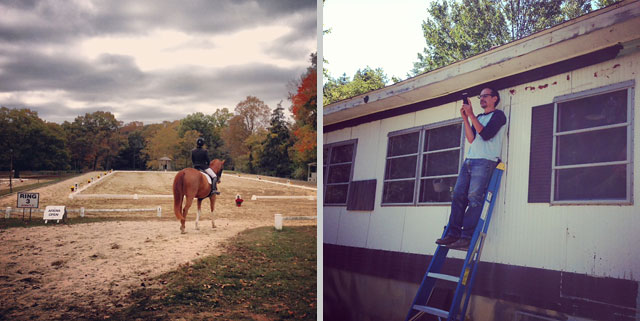
These are some of the photos I posted. Go to Instagram and search #foliophoto to see the work of the group.

For the prompts New and Look up

For the prompts New and Look up

For the prompts Ground and Favorite

For the prompts Ground and Favorite

For the prompts Yes and Antique

For the prompts Yes and Antique

For the prompts Feet and Red

For the prompts Feet and Red

hurricane sandy one year ago

One year ago today, we were holed up in our apartment listening to the screaming wind and watching the branches of the weeping willow in the garden crushing the fence and spilling onto the sidewalk. Here is my post from last year.

Today on this anniversary, I came across this haunting black and white video posted by Scream Machine showing the flooding of Loisaida Avenue. I’d not seen before how strong the storm surge was when it came up the avenue. About 3 minutes in, they’ve edited in still photographs of the aftermath.

bokashi composting

I love making something out of nothing. So I really like to compost. It makes me feel good to make use of trash – I like the crumbly black compost it produces and how my plants love it. Frank made me this compost system at our rural homestead out of found pieces of junk. The previous land owner worked in a school cafeteria and we found lots of these dinnerware racks for industrial type dishwashers. The racks worked out well for the compost bins, allowing for air circulation while being strong enough to hold up through winter snowstorms. Frank added found scraps of fencing and made it all sturdy with 2 by 4’s and rocks.

my compost bins

my compost bins

My system has three compartments. One is for fresh scraps. That is the active one I keep adding to. Two is for compost that is cooking – that one I let sit till its done. Three is for finished compost that I add to the garden. When the finished compost is all shoveled out, I use that compartment to begin again as the active number one.

new section made of found materials

new section made of found materials

Last fall, I went to a workshop during the 1st Annual Harvest Arts Festival in the community gardens of Loisaida. It was a workshop on the Bokashi method of composting taught by gardeners at the Children’s Garden on Avenue B and East 12th St. They reported that they’ve increased their production of compost manyfold and are now producing tons of compost annually. They also told us that apparently rats hate the Bokashi waste and don’t come around their garden anymore. I was sold when they stuck a pitchfork into a random section of garden path and revealed black loamy soil teeming with earthworms.

Bokashi is a Japanese term meaning “fermented organic matter”. Effective Microorganisms (beneficial microbes) are inoculated into a medium such as bran laced with molasses. This inoculated bran is then sprinkled onto food waste in a bucket then sealed airtight for about two weeks. The result is the fermentation of your food scraps that are teeming with good bacteria. The Bokashi’ed food waste can be buried near your plants to fertilize and improve the soil or added to your compost bin in order to super speed up the making of compost.

bokashi bucket ready with fermented food waste

bokashi bucket ready with fermented food waste

This summer I started my Bokashi composting with a bucket system in my apartment. They say that you can add meat and dairy to a Bokashi bucket since the fermentation will pickle the waste instead of rotting it. I don’t choose to do that. We put in only vegetable and fruit scraps, leftover rice or bread and the occasional cheese rind. After you put in some scraps, you sprinkle on the inoculated bran and seal the bucket. I keep doing that until it is full and then I let it sit for two weeks. It does not stink. It has as sour, yeasty smell, but it is definitely not rot. I then add it to my compost bin. The microorganisms turbo-charge the making of compost. When I turn my pile, the smell of earth and fertilizing matter is rich and heady. Obese earthworms swirl around my pitchfork.

I got my starter kit of inoculated bran and Bokashi buckets from Teraganix. I like the plastic covers that come with the buckets because they are very easy to get on and off. Some folks say that you should have a bucket with a spigot in order to drain off liquid every other day, but I don’t do this and I don’t have an overly soggy bucket.

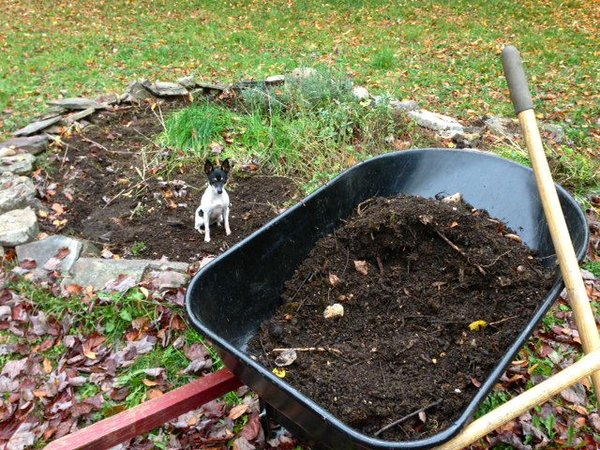
millie just loves to sit in the herb garden. compost gold ready to be worked into the soil.

millie just loves to sit in the herb garden. compost gold ready to be worked into the soil.

This past weekend I shoveled out my finished compost and worked it into the garden beds so that in springtime the soil will be prime for planting. Over the winter, I will bring my pickled food scraps to our community garden’s compost bins. And I will keep on making something out of trash.

Good resources for more information:

Teraganix has a blog and video in addition to supplies

Compost Guy – a great site for all things compost

loisaida tree beds

Street trees are tough cookies. They survive in bad soil and polluted air. They give us back oxgen, and in the summer they cool our walks with their shade.

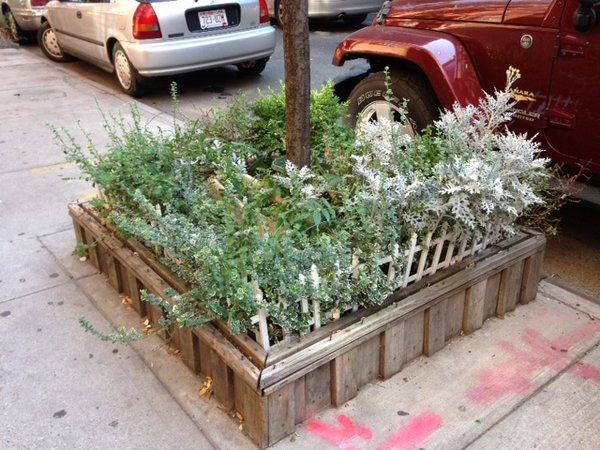
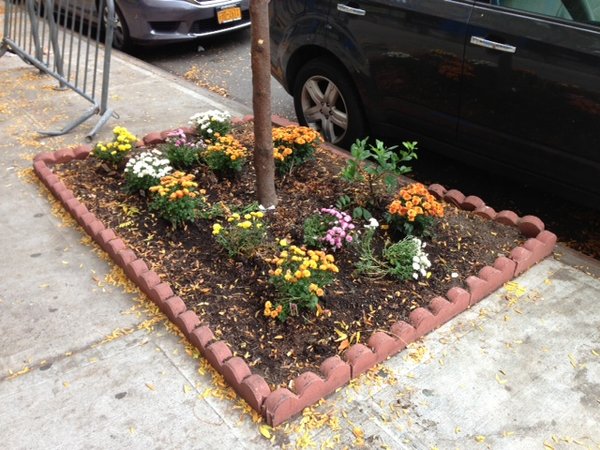
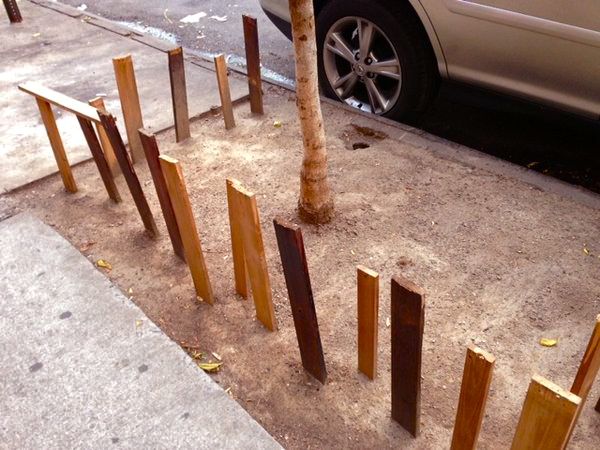
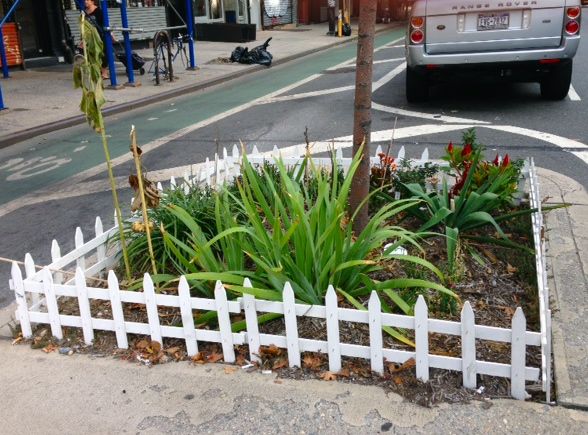
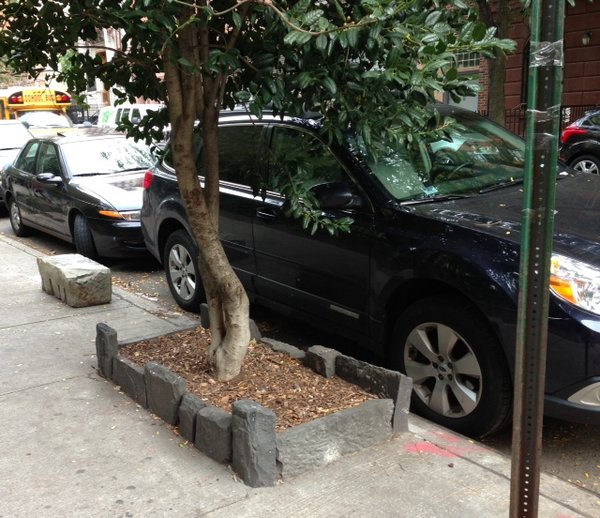
I like how people tend the street trees and create small gardens around the their beds. Here is a round-up of some of the tree beds in Loisaida this autumn.

wooden bed with white fencing

wooden bed with white fencing

a suburban look with mums

a suburban look with mums

lush bed garden with a bamboo fence

lush bed garden with a bamboo fence

metal tree bed fences make for good bike parking

metal tree bed fences make for good bike parking

a minimalist tree bed on Loisaida Avenue

a minimalist tree bed on Loisaida Avenue

this gardent was created and is tended to by my friend Raquel

this gardent was created and is tended to by my friend Raquel

tree bed made from the pieces of demolished tenements

tree bed made from the pieces of demolished tenements

herb harvest

It’s time to put gardens to bed so I say goodnight to my herb garden. You gave us such good meals all summer long. Three different kinds of basil on our tomato salads, parsley for the chimichurri on our steaks and fresh mint in our mojitos.

I harvest and freeze the fresh herbs so that this winter we can smell and taste the summer again.

Millie must have liked the smells in the herb garden because she liked sitting there when I weeded.

Millie must have liked the smells in the herb garden because she would always come and sit there while I worked.

herbI washed and chopped the fresh herbs and put them in water inside a muffin tin to freeze. That allowed me to freeze a larger amount than in an ice cube tray.

herb1

I then popped out the herb cubes and put them in a plastic bag in the freezer. Now I say hello to Fall.

power from the sun

When we got our land as a getaway from the urban jungle we made a trade-off. The land was beautiful, with a deep forest and a sunny meadow. It came with a trailer the size of our apartment, so that we did not have to build anything to be able to enjoy it right away. But, we had no electricity. We are totally off the grid.

We learned a lot from living without electricity for long stretches at a time in the summer. We learned about how to manage without refrigeration (the hardest part). We learned that two buckets of cold water straight from the well + 1 bucket of boiling water made the perfect amount of warm water for a long haired individual to bathe and wash their hair luxuriously. We read a lot because we could have no computer or TV. I attribute Oona’s extraordinary vocabulary to the fact that she read so much as a way to get out of working in the garden.

In the beginning, we used candles and oil lamps. The light from these was very romantic but dim. It was hard to read unless you were right under the flame and we all had headlamps so that we could read while sitting back on the couch. I do miss the ritual of snuffing out the candles at the end of the night with an old silver candlesnuffer that was found at a yard sale.

After the candles and oil lamps came the Nokero solar bulbs and the Ikea solar lamps. Those were a tremendous breakthrough and allowed us to get rid of the dangerous open flame lighting system. We set the solar lamps outside to charge up in the sun in the morning and hung them in the trailer at night. The Ikea solar floor lamp allowed us to lie back on the couch and read. The table lamps were super bright and we could comfortably read in bed at night. The Nokero bulbs spotlighted the kitchen sink and counters for cooking and clean up.
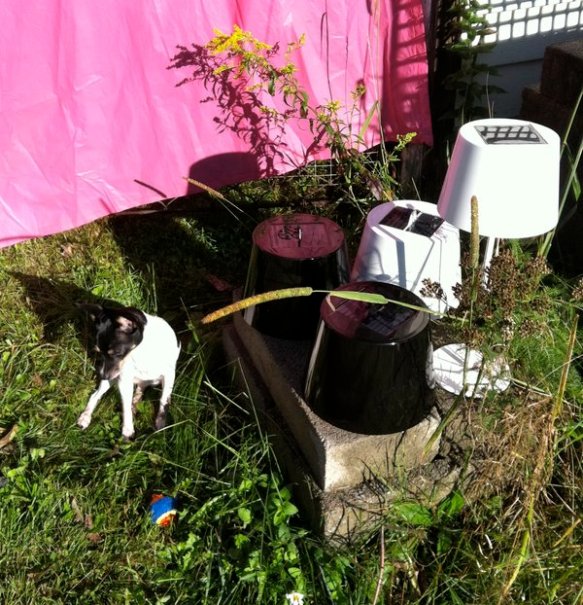
Charging up the Ikea solar lamps

Charging up the Ikea solar lamps

But we wanted more. Especially refrigeration. We once called the electric company to ask for an estimate for bringing poles to our property to hook us up to the grid. The nearest pole to us is only a half-mile away. They quoted us over $35,000. When we asked if they had a payment plan. The guy says, “Yes, ma’am, we sure do, but there is a 7 percent interest charge for the payment plan”. That’s when I got pissed. First, I researched, but the last rural electrification program was during the time of President Roosevelt. We were on our own and so we “did it ourselves”. Or I should say, Frank did it. He installed our very own off-the-grid solar power system. For very little money.
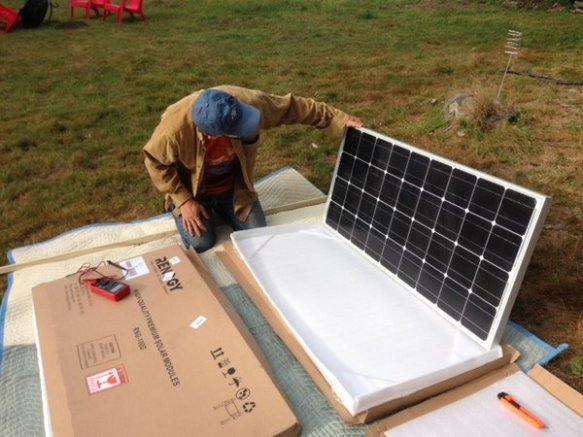
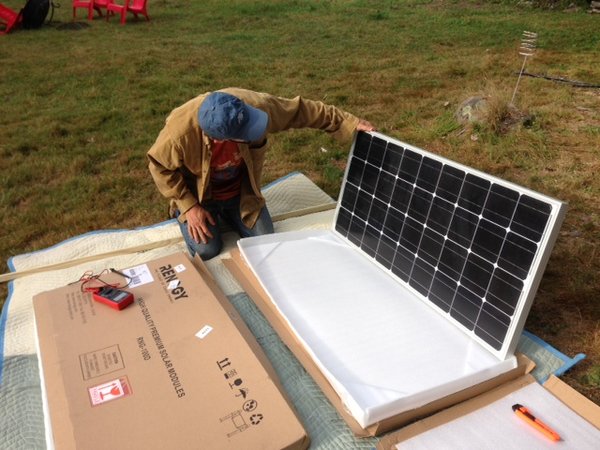
The panels arrive

The panels arrive

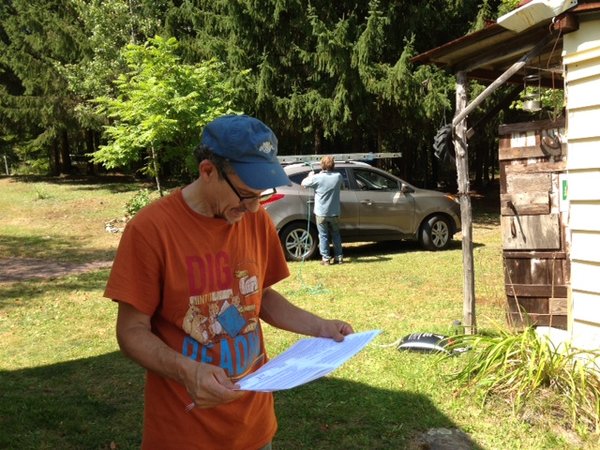
Frank spent months doing research and studying. He mapped out the system and the equipment needed. He did a lot of math and internet shopping. He became friends with solar energy vendors and electrical shop clerks. He spent almost a month this summer, walking around the property wearing a little apron full of screws, tinkering, building, pondering and tweaking. And now we have power. Clean and free energy from the sun. And when the power goes out for our neighbors during a storm, it will not go out for us. Our lights will still be on. We will be able to offer to charge their phones for a change.
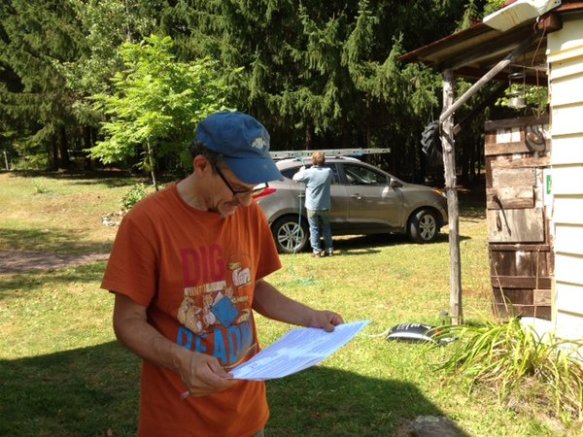
Frank
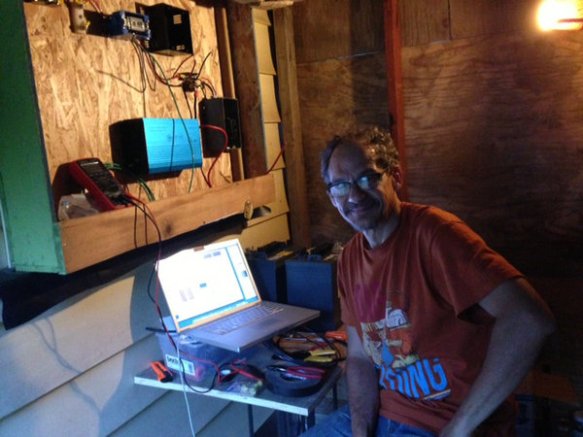
Frank

Solar power base of operations

Solar energy headquarters, work-in-progress
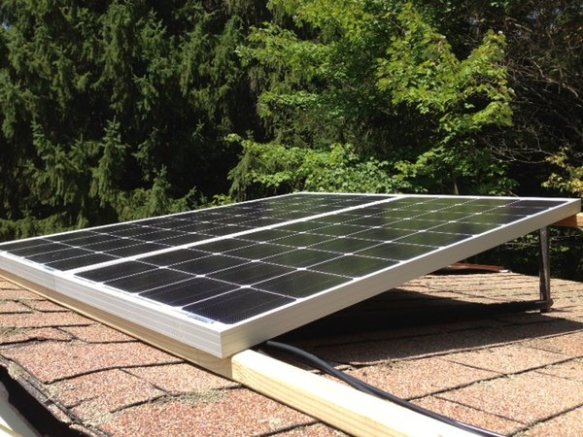
Solar panels installed
Solar panels installed

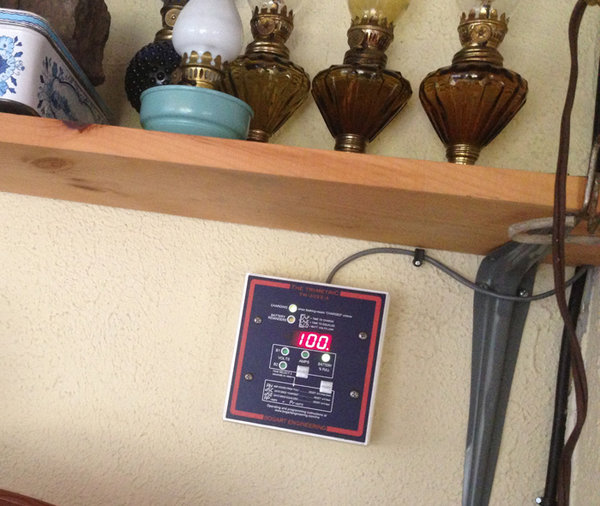
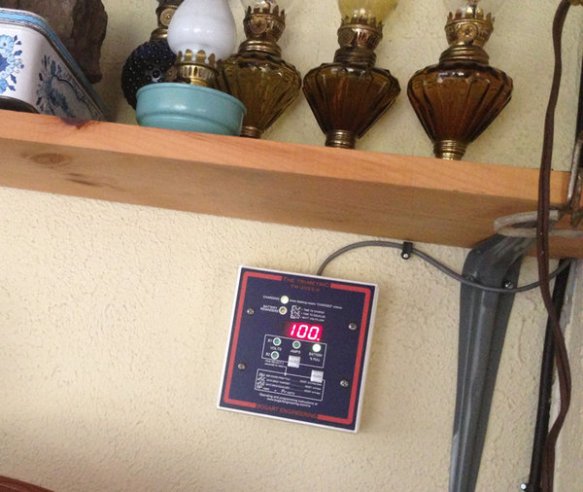
The trimetric monitor, our batteries are fully charged

The Trimetric monitor, our batteries are fully charged

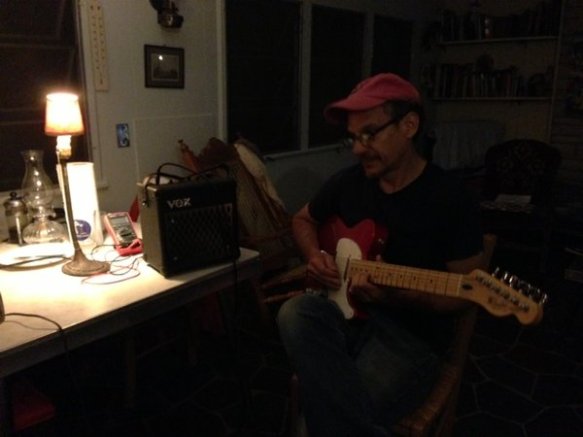
The first time we turned on the electric light, everything seemed too bright and garish. We were startled and blinked our eyes like people must have done when they first got electric lights in the home. It’s a good thing Frank attached dimmers to all of the lights.
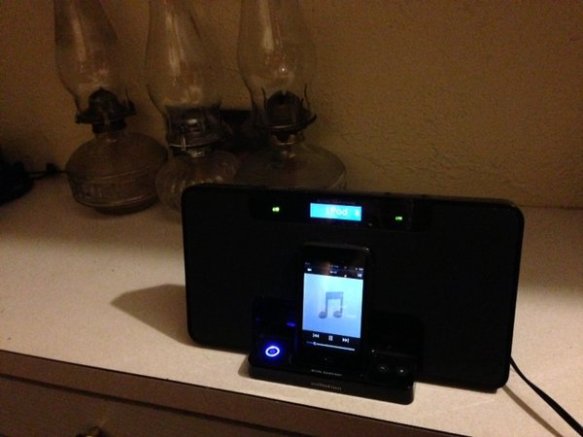
Our first night with electricity from the sun
Our first night with electricity from the sun

Solar powered electric guitar

Solar powered electric guitar